Some weeks ago I went to New York City with my son.
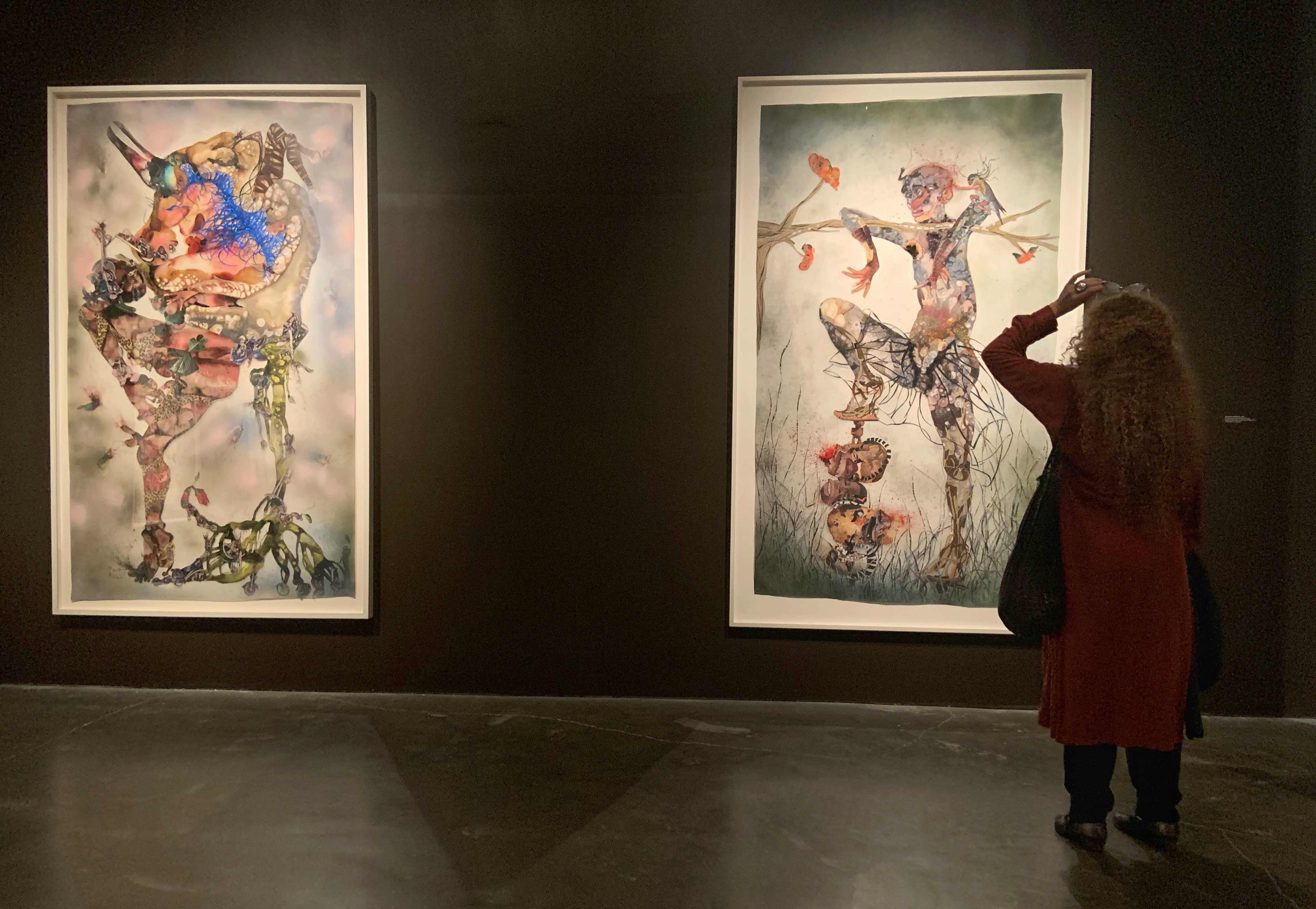
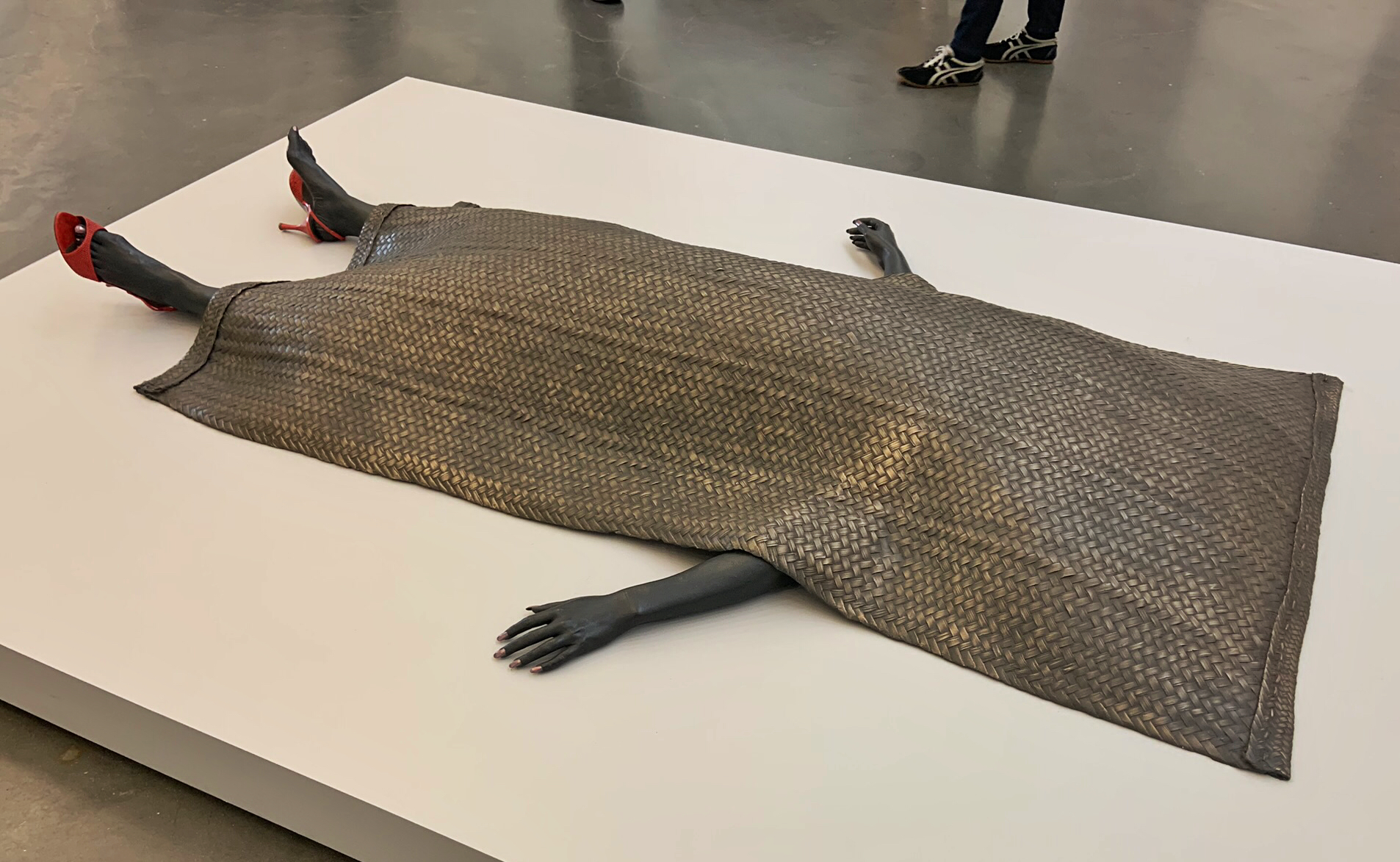
We landed early on the Wednesday, dropped our things at the hotel, and then made straight for the museum around the corner that was having a show of Wangechi Mutu’s work – a woman whose collages I’d long admired online.
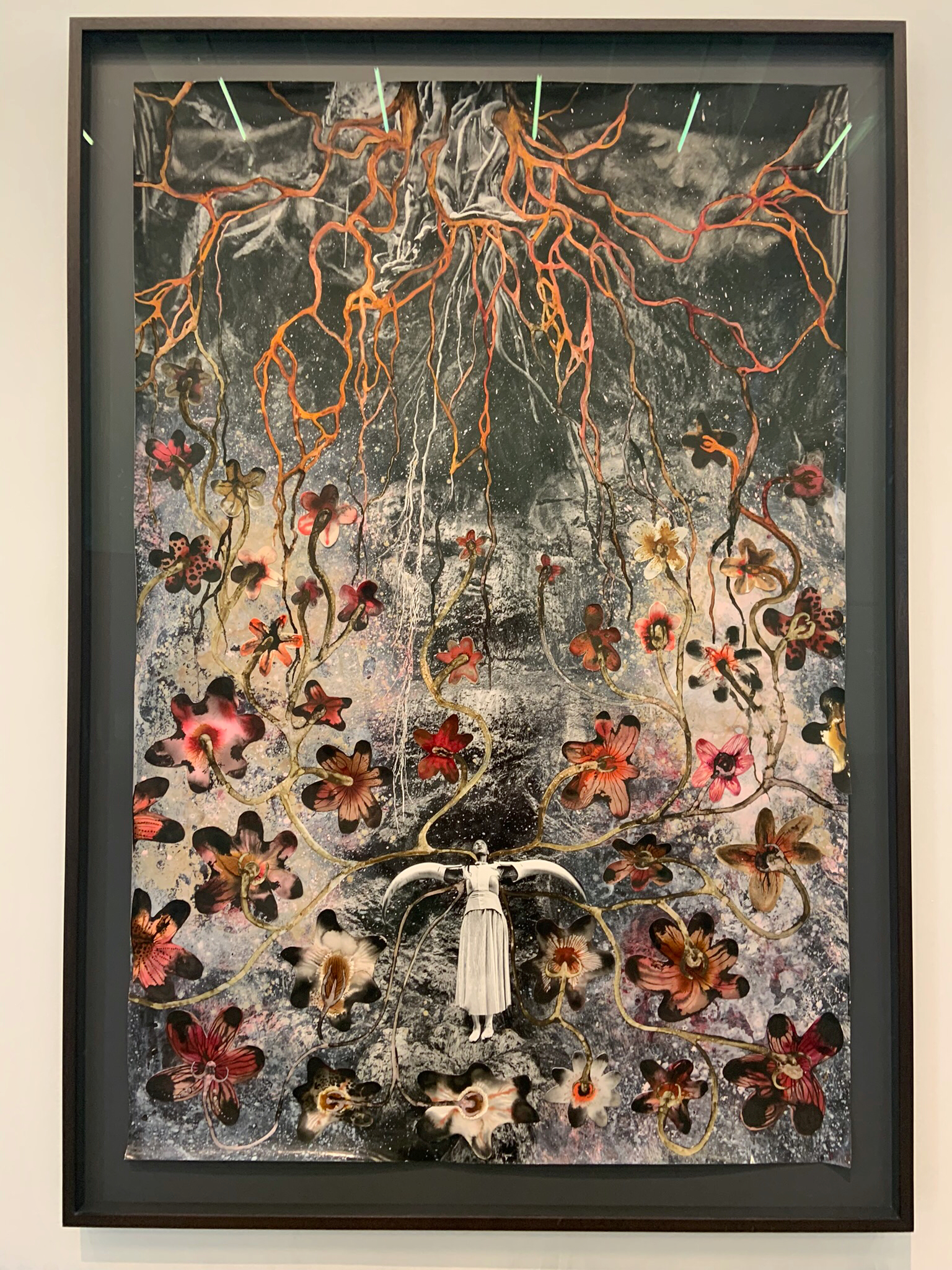
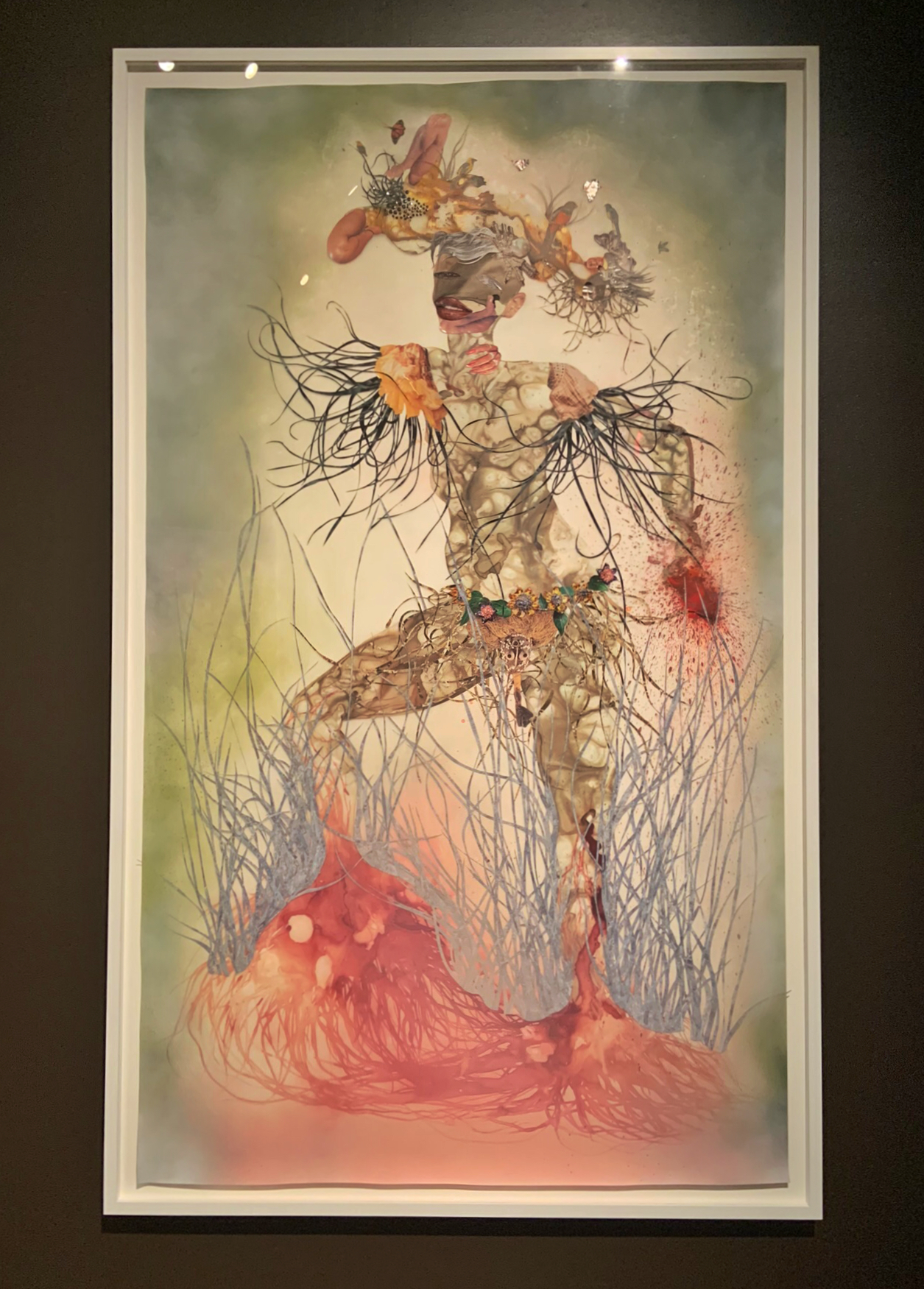
But OMG, the show was so much more than what I knew, and so much more than I expected… the early collages, but later paint-collages, sculptures and short films and installations – several floors of a lush, dynamite, gorgeous and frequently creepy body of work – a highly coherent and full retrospective of an artist in mid-career.
On the Thursday we had a lunch date with V, who I had never met in person, but knew from some online art classes and group critiques, from 2 years of regular zoom meetings hosted by our mutual teacher, Lisa Call.
And at some point there over lunch with V, talking about art and bodies of work, both she and I tried to explain the Helsinki bus theory to my son – a theory Lisa introduced to us early on in her classes, as a way to focus on one’s own path for long enough to get to a point of deep creative exploration and originality. We stumbled through our explanations, looking for how to say that if you stay on your one single bus long enough instead of trying each and every new thing, it will start to evolve into something that is original.
And once you start to see that difference in your work from the work you so admire—that’s why you chose that platform after all—it’s time to look for your breakthrough. Suddenly your work starts to get noticed. Now you are working more on your own, making more of the difference between your work and what influenced it. Your vision takes off.”
Arno Rafael Minkkinen
Lisa had us consider this way of thinking early on in our work with her, along with a process of what she called “closing doors” – closing the doors to all the things you are NOT going to do, so that you can focus on what you ARE going to do. And in a way, the narrower, the better – challenging, but also a clearing of the dross.
So looking at the work of Wangechi Mutu, it was so clear she had stayed on her bus – but the interesting thing was, that her materials were able to change quite radically through the years, and it was her thematics that stayed true and focused like a north star throughout.
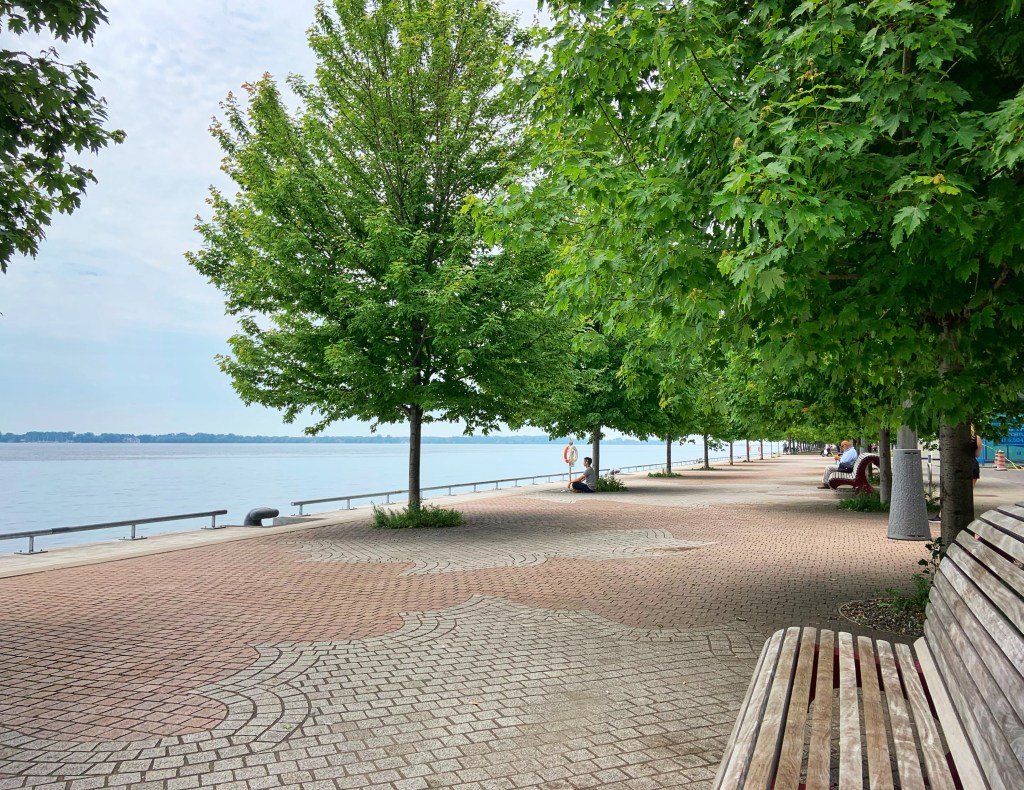
I’ve been trying to start a daily habit – to get out the door first thing every morning and say hello to the lake.
The morning is my favourite time – the light is beautiful, the day just beginning, and there is hardly anyone around except the geese, the gulls, the ducks, and the diving cormorants
The few people who are out are doing inspiring things like yoga, or jogging, or even finishing up that report from a beautiful spot.
All in all, you would think this new habit would be a) easy enough, not overly ambitious, not going from sedentary to marathon in a week kind of thing and b) highly pleasurable – it is, as they suggest, a small enough habit to start with, and it is a blessing on my day every time I do it.
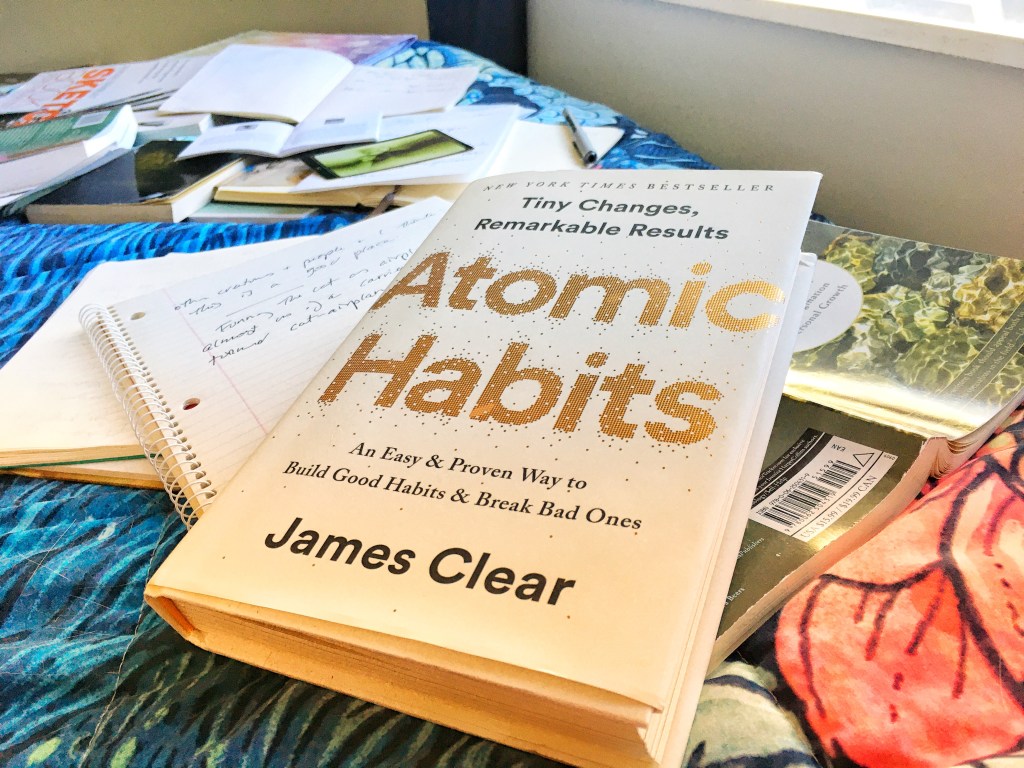
…a regular practice or routine that is not only small and easy to do, but also the source of incredible power; a component of the system of compound growth.
…the effects of your habits multiply as you repeat them. They seem to make little difference on any given day and yet the impact they deliver over the months and years can be enormous.
On her About Manda page, written in a unique tense, she describes the period of her life when she wrote a seriously ambitious historical fiction series:
Six years of Boudica dreaming. Throw out the TV. Throw out the sound systems. Light the fire every night and let it teach me. By the end, have lost all touch with consensus reality.
~Manda Scott
The television bit and the fire every night bit I’d heard before, but the sound system??? She says: “recorded music is one of our strongest addictions”.
This is deeply radical. This blows my mind. I’d discovered the enormity of music in my life during one of my current habit experiments, which is to make the studio a wifi free zone. Not having a phone to reach for is the key piece – I have to deliberately leave my phone at home and walk over to the studio without anything that connects to the internet. The idea is that, distraction free, I will spend more time in deep thinking, or at least deep being, if there is nothing to plug into.
And the first thing I discovered was how much I missed playing music.
The phone and Facebook and whatever I can live without for a few hours, even for the day… but no music…??? I am deeply deeply hooked into music as a kind of mood designer.
So, thinking about just how deep one could conceivably go with lifestyle changes (can’t light a fire every night in downtown Toronto, but maybe there are other things…) I’ve tried to change up even the tiniest of habits, to experiment and try new things. You know, just those deeply engrained little things like brushing your teeth with the other hand.
Or, the other afternoon, on my way to a backyard BBQ with friends, rather than take the obvious bike route along King, across the bridge over the Don and along Queen East into Leslieville, I got out the map and explored some twisty bike lanes that take you over little hidden bridges and under underpasses and down onto the Lakeshore bike path. It’s still kind of unfamiliar territory for me, but shucks, there was dozens and dozens of folks out there with some serious looking biking habits.
All big things come from small beginnings. The seed of every habit is a single, tiny decision. But as that decision is repeated, a habit sprouts and grows stronger… The task of breaking a bad habit is like uprooting a powerful oak within us. And the task of building a good habit is like cultivating a delicate flower one day at a time.
~ James Clear
Meanwhile, with some BC friends we’ve begun a daily drawing challenge – each evening one of us sends a prompt to the others, and the next day we each respond to that prompt with a drawing. Some days have produced some pretty terrible drawings, but by coming back to it (almost) each and every day, there are some drawings where I can really see my skills developing –
And my morning lake-visiting habit???
At the moment I’m averaging about every other day.
There are still days when, distracted by the inviting option of coffee on the balcony, watching the skies and scanning the construction site below, searching for the resident bunnies and foxes who can occasionally be spotted darting out from underneath sheds and pipes, I indulge in that strangely sweet uber-urban homey feeling.
So, for now, on those days I don’t make it to the lake first thing, I’ve been making sure to do it at some point during the day. This is not the ultimate goal but is a temporary compromise, and it has reminded me of how fun it is to see the same body of water at different times of day.
The glaring sun and choppy waters of a mid-day, can turn into a magical evening in exactly the same spot.
And in the evenings, turns out people are bringing boom boxes and coolers of beer and skateboards and portable disco balls, and setting up sweet mini parties and dancing underneath the trees by Sugar Beach. Small groups, as is proper during a pandemic, but such creative and romantic ways to enjoy our tiny sliver of city lake front.
Back in April, in the most lockedness of lockdown, I still had a roommate – a woman from Vancouver, stranded in Toronto – and she would stay in the apartment all day every day, while I would venture out to the grocery stores and on over to my studio, my sanctuary.
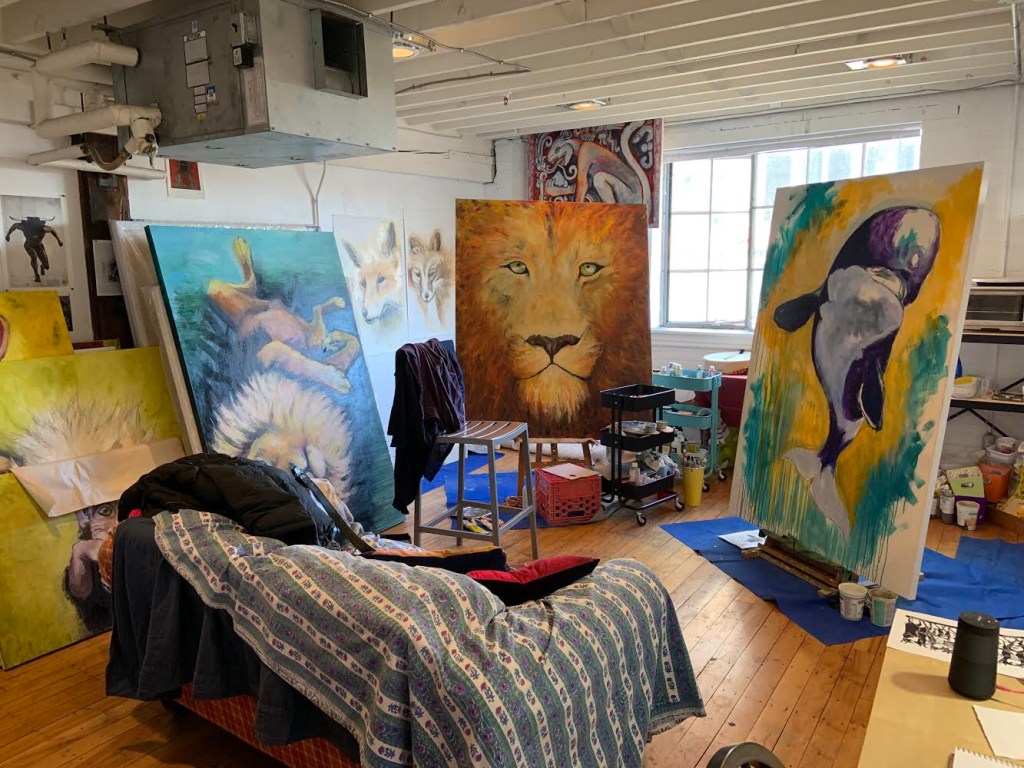
But in those still more wintery than spring days of April, I would arrive to this room full of giant 5 and 6 foot paintings of animals, look around and just burst into tears.
Something about the scale, the sense of power, the confidence and apex predatorness… I just could not relate to any of it. Who was the person who had begun painting these? There was so much still to do to finish each of them, but I could not summon or even fathom any of that kind of big energy.
After several afternoons of just sitting on the couch looking around, I realized I would have to try something different, for the moment at least. I remembered a suggestion from Eric Maisel (I think it’s in his Fearless Creating book) to just go to the studio and squeeze some paints onto the palette. Just that.
So I started there.
And then the next thing I did was put some colours on some cheap sheets of canvas paper and moved them around. No image. Nothing representational. Just moving the paint around.
The following week I started to bring fruit. Stopping in at the No Frills on my way over, I’d pick up a few shapes, a few colours. I set up a little spot with a light, and put out the fruit.
From years ago when I did still lives all the time, I still have the tiny little masonite boards ready to go, so I did a series of pretty terrible paintings of fruit. But it was something, it was still moving the paint around.
And in between there were days when even dealing with paint seemed like a lot, so I would just draw. Pull out a sketchpad, some charcoal, and just exercise that hand eye communication – the pleasure of close observation.
But the drawings on their own felt a little bald, so on the iPad I started adding a bit of colour after the fact.
By now weeks had passed, the roommate had gone home to Vancouver, and spring had fully sprung and the trees were leafy and green and full, and I would pass them as I did my rounds – my extended route along the lake front, then circling back along the wide park boulevard of Esplanade and over towards the studio – and I started to pluck a leaf here and there, relishing their smell, their aliveness.
Being a city kid through and through I can’t tell one kind of tree from the next, so I downloaded an app to find out what each one was. At night I listened to audiobooks of The Hidden Life of Trees by Peter Wohlleben, and The Overstory by Richard Powers – both magical, wonderful books.
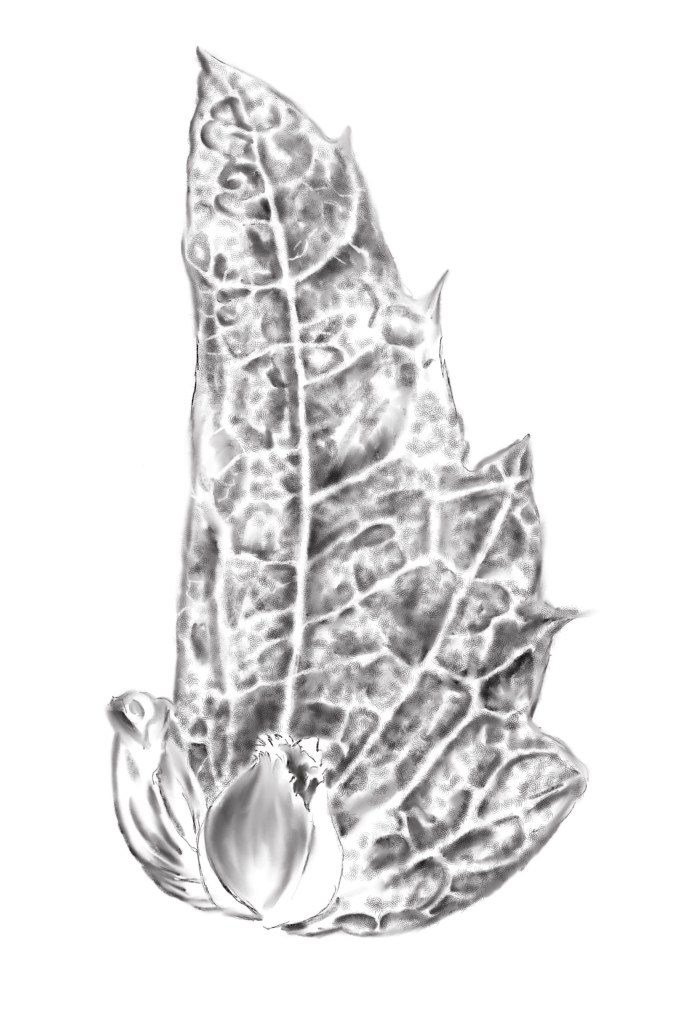
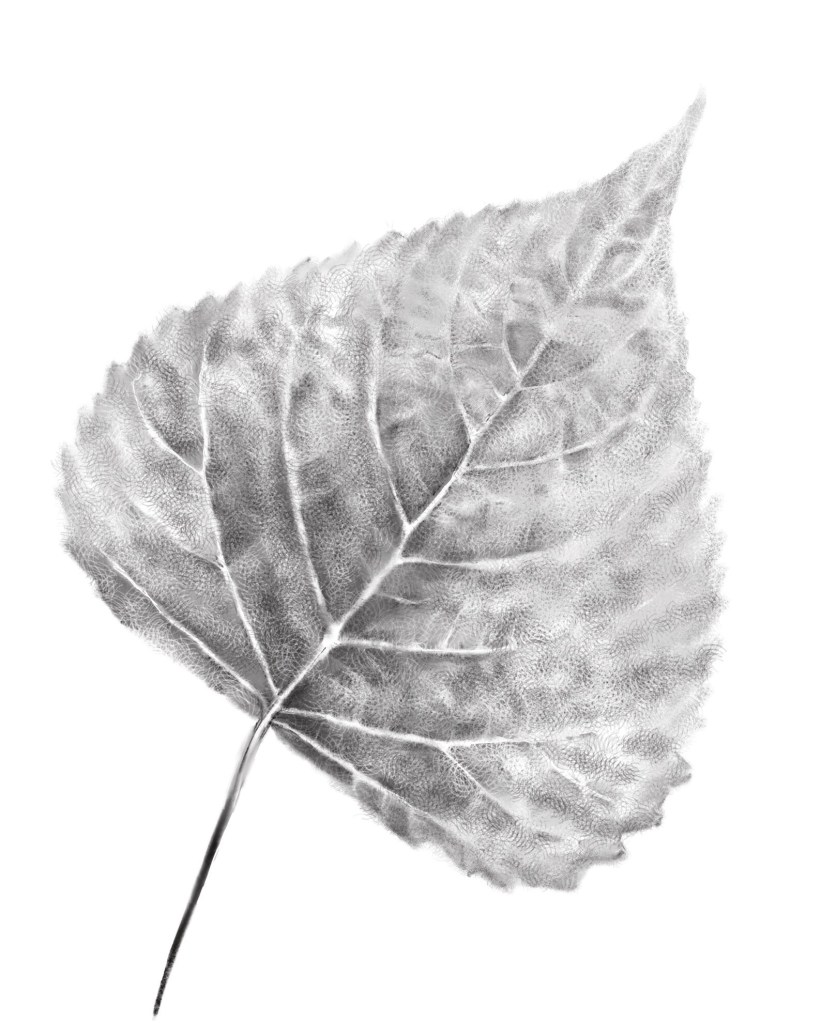
And then I started to draw the leaves I was picking on the iPad.
These, I like.
Here, finally, was something new emerging that felt like it might go somewhere.
My huge animal paintings are still waiting patiently to be finished, to have the final layers and touches completed, but in the meantime, there is a new seed of something beginning…












 follow your nose